
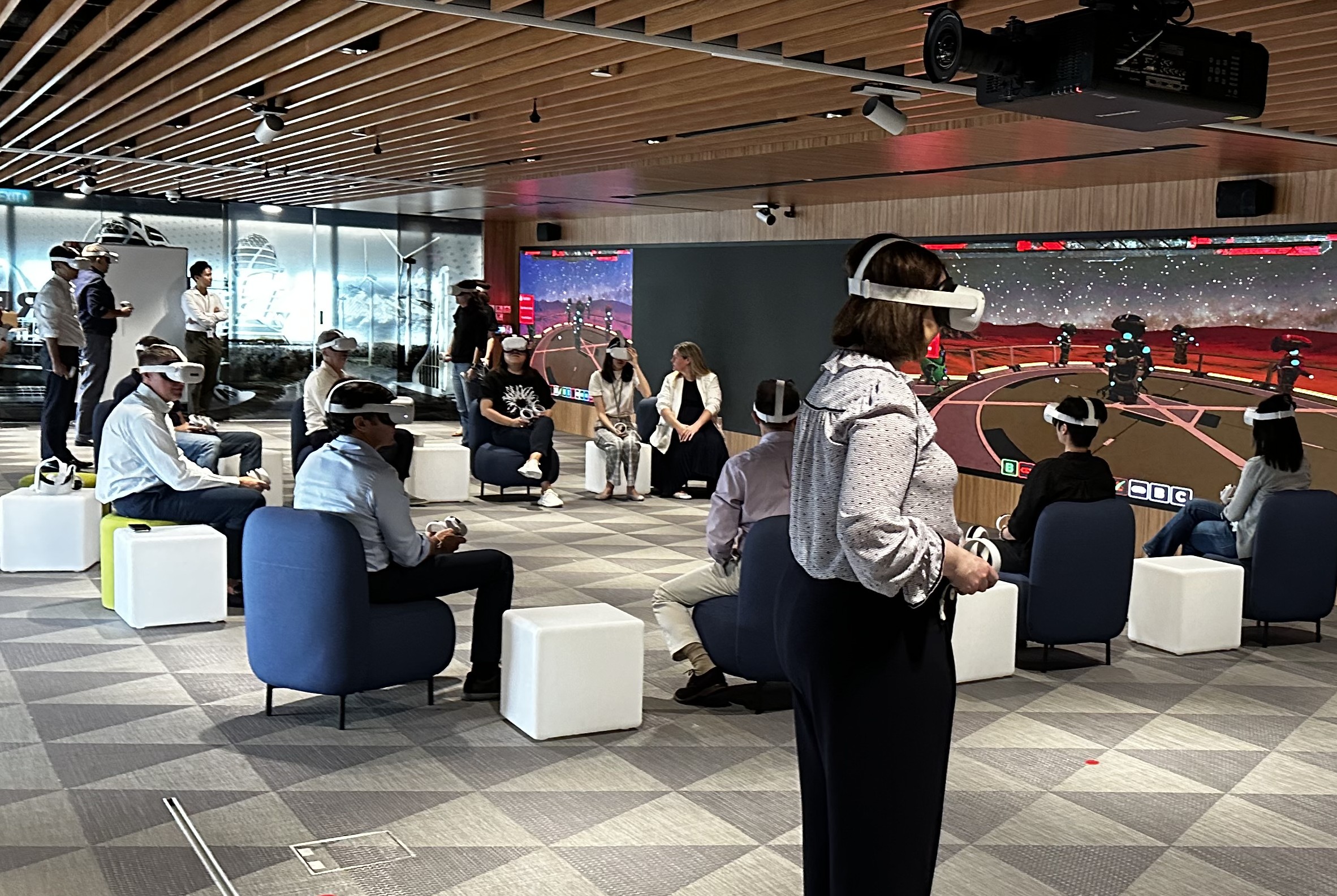
The first thing that showed up in the headset wasn’t the virtual environment. It was the real leadership habits people live by every day: the “I’ve got this, just do it myway” voices that usually dominate the room.
In the early debrief of a recent Jenson8 VR workshop for a global tech manufacturer, a few participants took over the conversation, convinced they had the right answer and the right way forward. By the final debrief, those same voices had shifted:they were listening, asking, and actively making space for others’perspectives. The behaviour change didn’t just happen in the game; it became visible in the team’s real-world discussions.
Seeing The Whole System, Not Just Your Task
One of the most powerful roles in the simulation was the “observer/CEO” seat: the person whocan see the bigger picture, spot patterns, and question assumptions about howthe team is actually operating. In theory, it is the perfect vantage point forstrategic leadership
In practice, even that role got sucked into “production mode”. Critical clues about how components moved, how the metaphorical conveyor belt really worked, and what that meantfor the mission were missed because participants were doing rather thanthinking. The parallel to the business was obvious: when everyone is consumedby activity, nobody is really looking at the system.
The Moment The Conveyor Belt Snaps Into Focus
A pivotal moment wasthe “conveyor belt” revelation – the point where participants realised a key assumption they had been operating under was simply wrong. That single shift unlocked a cascade of insight about how often teams in the business run hard inthe wrong direction because no one stops to challenge the underlying logic.
Handled well, these moments become more than a clever game twist; they turn into the kind of “we will remember this in every project review” experience that changes how people approach account planning, virtual teams, and complex deals.
Why FacilitationMakes Or Breaks The Value
The workshop onlyworked because the facilitation never let the experience sit as “just a funactivity”. Every pattern in the simulation was tied back to how the business actually runs: communication under time pressure, accountability, role clarity,and when to ask for help rather than micro manage.
Participants left with concrete, shared language:
From VR Back To The Business
By the end, the impact was visible in the meeting room as much as in the headset. Communication was sharper, more inclusive, and more deliberate; participants were more conscious of each person’s “superpower” and the limits of their own]
The strongest takeaway, captured by the internal psychologist observing the session, was simple: never assume the way we are currently working is the most effective route to the objective. In this case, it took a VR mission to make that truth impossible to ignore back in the real world.