
When Reality Isn’t Real Enough: What VR Reveals About Human Behaviour
Most leadership development programs promise transformation through reflection, frameworks, and dialogue. Yet research in behavioural science tells us that real change rarely comes from discussion alone — it comes from disruption. People don’t rethink their assumptions when you tell them to; they do so when their mental shortcuts collide with lived experience.
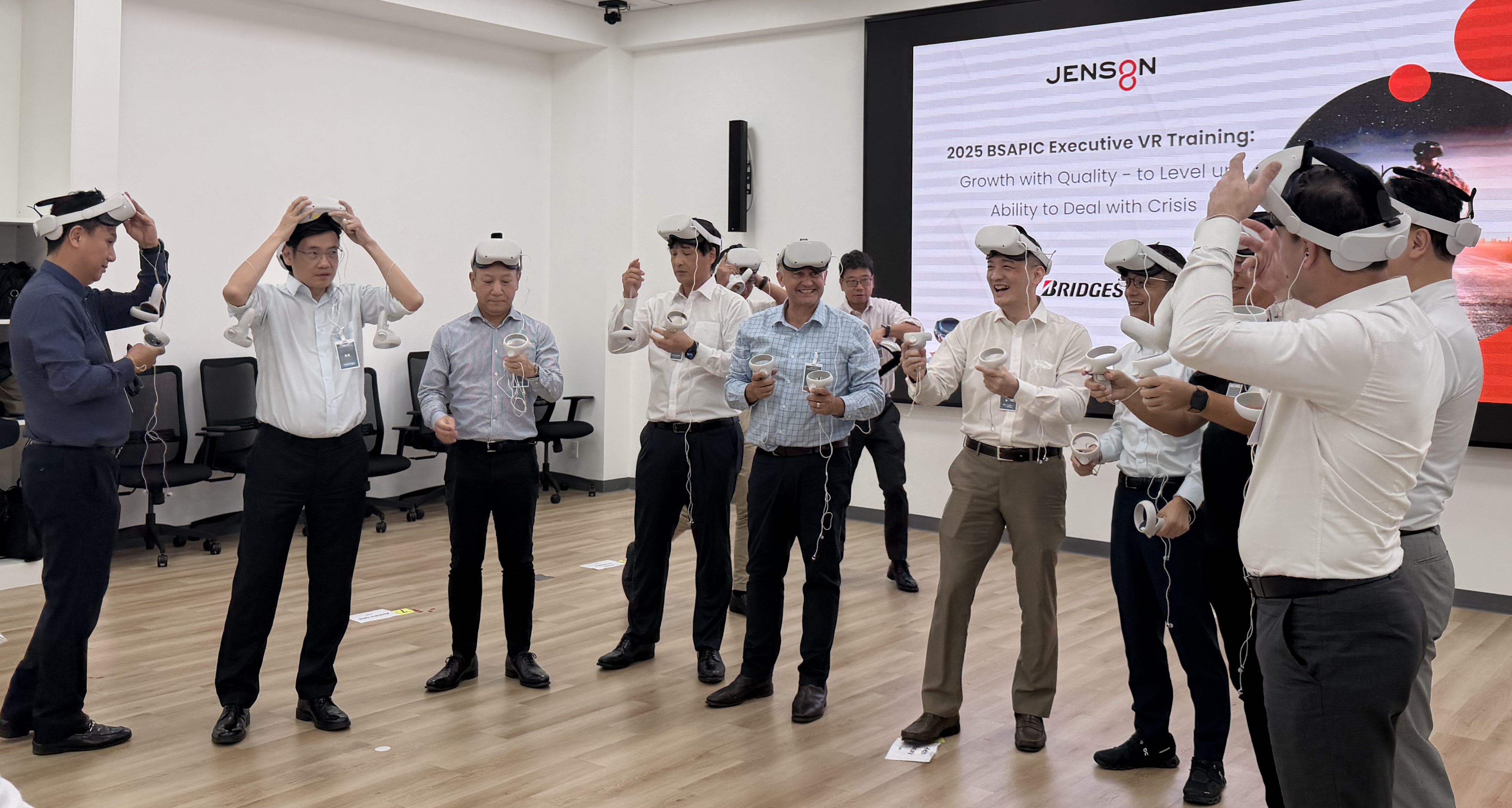
This is what makes immersive environments like Jenson8 so powerful. By blending virtual realitywith behavioural observation and guided reflection, leaders encounter an experience that bypasses theory and triggers genuine human insight. They don’t merely talk about collaboration, communication, and decision-making —they live it, under pressure.
The Moment Reality Bends
Within minutes of immersion, participants face ambiguity, time pressure, and complex inter dependencies that feel eerily familiar to corporate life. In these moments, leaders reveal more than they expect. The confident become cautious;the quiet find their voice; and those who claim to “see the big picture”discover how easily they can lose sight of it.
Observers frequently notice the same pattern: dominant personalities open the session with “Follow my lead, I’ve got this.” By the final debrief, those same voices invite others in — “What am I missing?” This behavioural shift is not coached; it’s emergent.It happens because the environment mirrors the social and cognitive tensions of real work — hierarchy, uncertainty, and incomplete information — and participants must adapt to succeed.
The Behavioural Mechanics Behind the Shift
Behavioural science has long understood that behaviour is context-dependent. System 1 thinking,as described by Daniel Kahneman, operates automatically and efficiently but is prone to bias. Under pressure, our brains rely on these shortcuts to conserve energy, often leading us to misjudge, overcommit, or ignore subtle cues.
In the virtual environment, these habitual responses play out in heightened form. Teams undertime pressure may double down on flawed assumptions — "the conveyor belt must lead to the exit” — because ambiguity and cognitive load limit rational analysis. What follows is a live demonstration of bounded rationality (HerbertSimon): decision-making constrained by imperfect information and time.
When participants pause to reflect — often prompted by failure or dead ends — they begin to engage in metacognition, or thinking about their thinking. The ability to recognise one’s own bias in real time is one of the most advanced forms of self-awareness. Few traditional training methods evoke it so vividly.
The Observer Effect: Seeing the System
One participant role —the “Observer” or “CEO” position — provides a distinctive lesson inperspective. While given a vantage point to see the entire operation, many observers still find themselves drawn into tactical firefighting. What shouldbe a strategic viewpoint often collapses into operational involvement.
This behaviour parallels what we frequently see in business: leaders pulled into daily execution at the expense of reflection and systems thinking. When facilitators connect this insight back to organisational life — account planning, virtual team leadership, or cross-department alignment — participants make the link immediately. Context, not character, drives much of their behaviour.
The revelation isn’t about performance skill, but awareness: great leadership often demands restraint, observation, and trust rather than direction.
From Play to Performance
Sceptics might ask: is an couple of hours in a virtual world really enough to change real-world behaviour? The data from behavioural learning suggests that it can — if the experience triggers emotional engagement and structured reflection.
Three mechanismsexplain why immersive learning sticks:
The combination ofemotion, reflection, and shared discovery produces change that endures farbeyond the headset.
Why Leaders Should Lean Into Discomfort
What stands out from hundreds of sessions is not just how people behave in the game, but how they behave afterwards. In subsequent meetings, communication becomes clearer, hierarchies soften, and colleagues start questioning assumptions earlier.
The real learning isn’t about the “right way” to solve a virtual challenge. It’s about confronting the cognitive and social dynamics that define every team: assumption, dominance, silence, trust. Those insights are not theoretical —they are embodied.
Leaders who embrace this discomfort gain something rare: unfiltered behavioural data about themselves and their team dynamics in a safe but revealing environment. It’snot about game performance. It’s about seeing reality — the real one — through a truer lens.
Seeing What’s Usually Hidden
In the end, the powerof immersive behavioural training lies in exposure, not instruction. Everyperson leaves the experience with the same reflection, phrased differently:
“I didn’t realise how much I was assuming.”
“I thought I was leading — I was managing.”
“I saw how little I really listened.”
When leaders and teams face these truths collectively, transformation begins. Because the only thing more revealing than reality — is a reality that forces you to see yourself.
The headset comesoff. The insight stays on.