
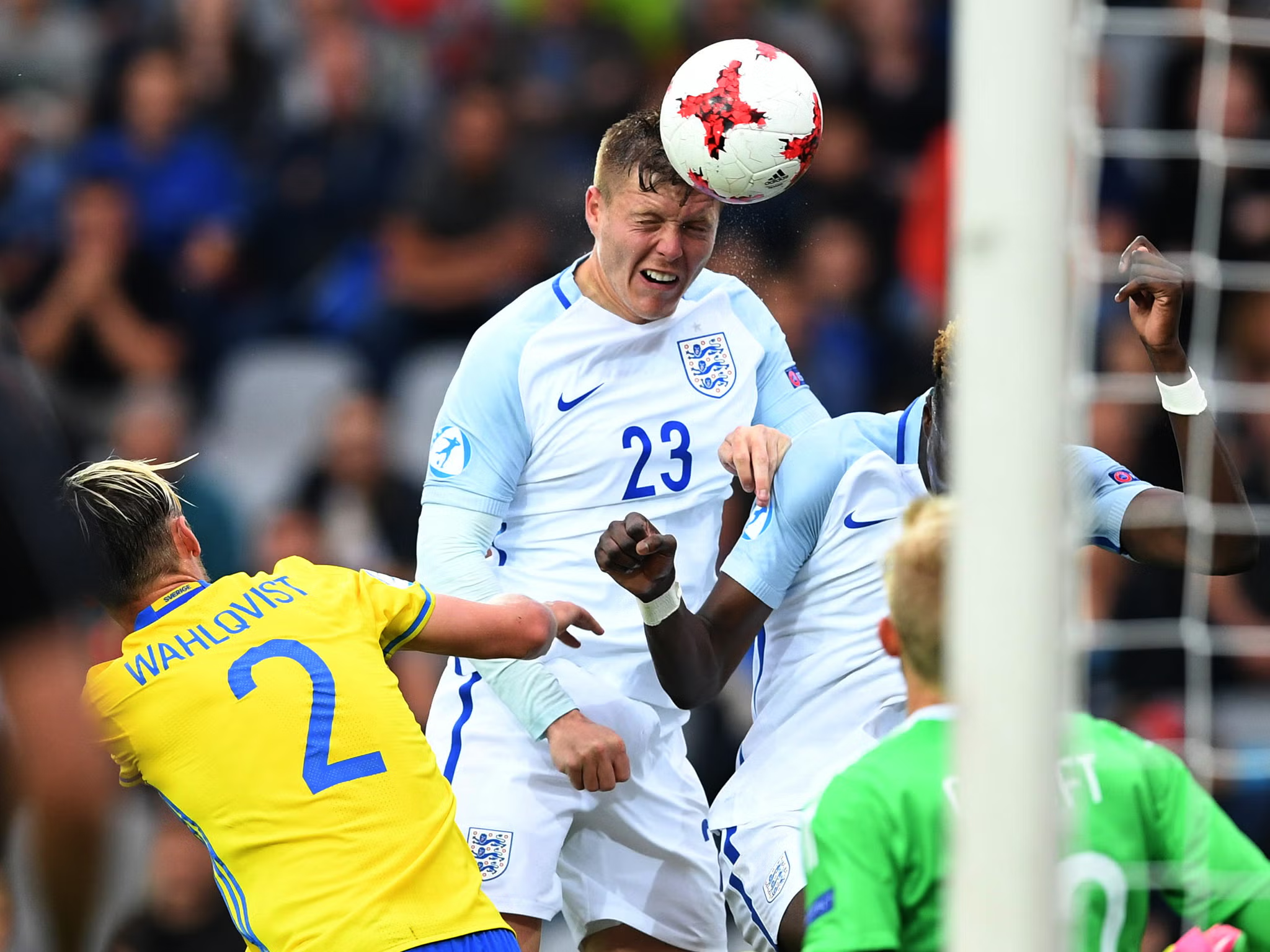
Teamship in the spotlight
It is easy to watch England’s 3–2 victory over Mexico and talk purely in terms of tactics, refereeing controversies and altitude. A quickfire double from Jude Bellingham, a Harry Kane penalty, a red card, a weather delay, and the noise of 80,000 people inside the Azteca make for a gripping narrative on their own. But beneath the drama sits something quieter and more durable: the architecture of teamship that allows a group to keep its shape when everything around it becomes unstable.
In this context, Jenson8’s Jena Davidson sat down with Alfie Mawson, a player who has lived that instability at multiple levels of the game. From academy beginnings and loan spells to Premier League campaigns and a final chapter back at Wycombe Wanderers, Alfie’s journey now continues in a different role: remote-based talent ID scout for City Football Group, analysing emerging 16–21-year-old players around the world. His view on “what makes a real team” is informed not by theory, but by dressing rooms where the stakes were tangible and unforgiving.
The Wycombe lesson: togetherness when the odds are stacked
When asked which team taught him the most about being part of a genuine collective,Alfie didn’t reach for a glamour club. He went back to Wycombe. At the time of his first spell there, they were in League Two, coming off a season in which they had barely avoided falling out of the Football League. The club was owned by the supporters’ trust, working with one of the lowest budgets in the division and dealing with significant injuries.
Yet this same group spent long stretches at the top of the table and marched all the way to the play-off final. The turn around was not built on financial firepower or individual stardom. It was built on a core of seasoned professionals players who had experienced both promotions and relegations, willing to share that experience with younger teammates. Alfie described how he would “pick little nuggets” off senior players, fully aware he might be testing their patience, but driven by a desire to improve to help the side.
One of his most striking observations is that the lower down the pyramid you play, the more tightly knit the dressing room can become. Ego doesn’t disappear, confidence and a certain edge are still required, but status tends to be earned through reliability rather than reputation. Everyone knows that if they do not collectively over perform, the outcomes are unforgiving. This dynamic creates an intensity of support and challenge that many corporate teams never experience, even though the principle is entirely transferable: when resources are constrained, culture becomes the differentiator.
Leadership without the armband
Another thread running through Alfie’s reflections is that leadership in football is rarely confined to the person wearing the captain’s armband. Jena invited him to talk about influential teammates who shaped him, and the difficulty he had in picking just one is telling. Across clubs, he encountered characters whose impact on the dressing room far exceeded their official role: senior players who set standards through everyday behaviours, not speeches; individuals who could hold a room in moments of tension without ever being formally designated as “the leader”.
These informal leaders create psychological scaffolding in teams. They are the ones who absorb frustration after a poor result, who turn injuries into shared responsibilities rather than private misfortunes, and who redefine what “normal” looks like during a season. They are also often the players younger teammates approach for advice, quietly passing on norms and expectations that will outlast any one campaign.
Incorporate terms, this maps closely to what Jenson8 describes as teamship: the lived behaviours through which leadership, collaboration, resilience,communication, problem-solving and adaptability show up under pressure. You do not see these behaviours on a tactics board, but you feel them in how a team reacts to a set back, how it treats those on the sidelines, and how it uses experience to protect and accelerate emerging talent.
Staying part of the team when you can’t play
Perhaps the most human part of the conversation came when Alfie talked about injury. His knee problems were persistent and ultimately career-ending, culminating in a specialist telling him that no responsible surgeon would advise him to continue playing. Many players in that situation retreat physically and psychologically from the group, driven by the understandable desire to fix themselves and “get back as quickly as possible.”
Alfie’s reflection is more nuanced. He points out that an injured player still has a choice in how present they remain in the environment. He recalls long-term absentees returning to the training ground a month after ACL surgery, barelyable to move but smiling simply because they were back among teammates. That visible joy becomes a subtle cue to the rest of the squad: we owe it to this person to keep the team in good shape while they recover, so that they come back into a healthy environment rather than a demoralised relegation battle.
There is a clear analogue here for organisations managing long-term absence, whether due to illness, parental leave, or secondments. The message is that inclusion is not a binary state of “in or out.” A person’s capacity to contribute may be reduced, but their role in shaping the team's emotional climate remains significant. Recognising and designing for that helps maintain cohesion through disruption.
From the Azteca to the office: what England–Mexico reveals about teamship
Overlay Alfie’s stories with England’s victory over Mexico, and a broader pattern emerges. In Mexico City, England dealt with a severe weather delay, hostile altitude conditions, a red card that left them playing with 10 men, and an intense late surge from the hosts. The conversation after the match naturally focuses on Bellingham’s goals, Kane’s penalty and Thomas Tuchel’s frustration with officiating.
Yet sustaining performance through that level of volatility depends on the same elements Alfie emphasises: experienced players who have lived both success and failure; emerging talent supported by a robust cultural frame; and a collective willingness to withstand pressure rather than allow it to fragment the group. Whether you are fighting for promotion with the lowest budget in League Two or defending a lead with ten men in a World Cup knockout tie, outcomes hinge on how deeply those invisible structures are embedded.
For leaders outside football, this offers a practical translation:
· Build multi-level experience into teams, mixing those who have “seen it all before”with those who are still forming their professional identity.
· Treat informal leaders as central assets, not incidental personalities. They are often the carriers of culture.
· Design ways for sidelined or absent colleagues to remain part of the narrative, so that their return is to a team that has grown, not fractured.
· Remember that resource constraints and difficult contexts can be fertile ground for strong teamship when approached deliberately.
At Jenson8, we work with organisations to surface and strengthen exactly these dynamics through immersive experiences like Boomathon, Apollo, giving teams a safe-but-challenging arena in which to test how they respond when conditionssuddenly change.
Alfie Mawson’s journey, from selling fruit and fighting for a career he once doubted he would have, to playing at the highest level and now shaping the futures of young players, is a reminder that the most powerful lessons on teamship often come from those who have lived both ends of the spectrum.