
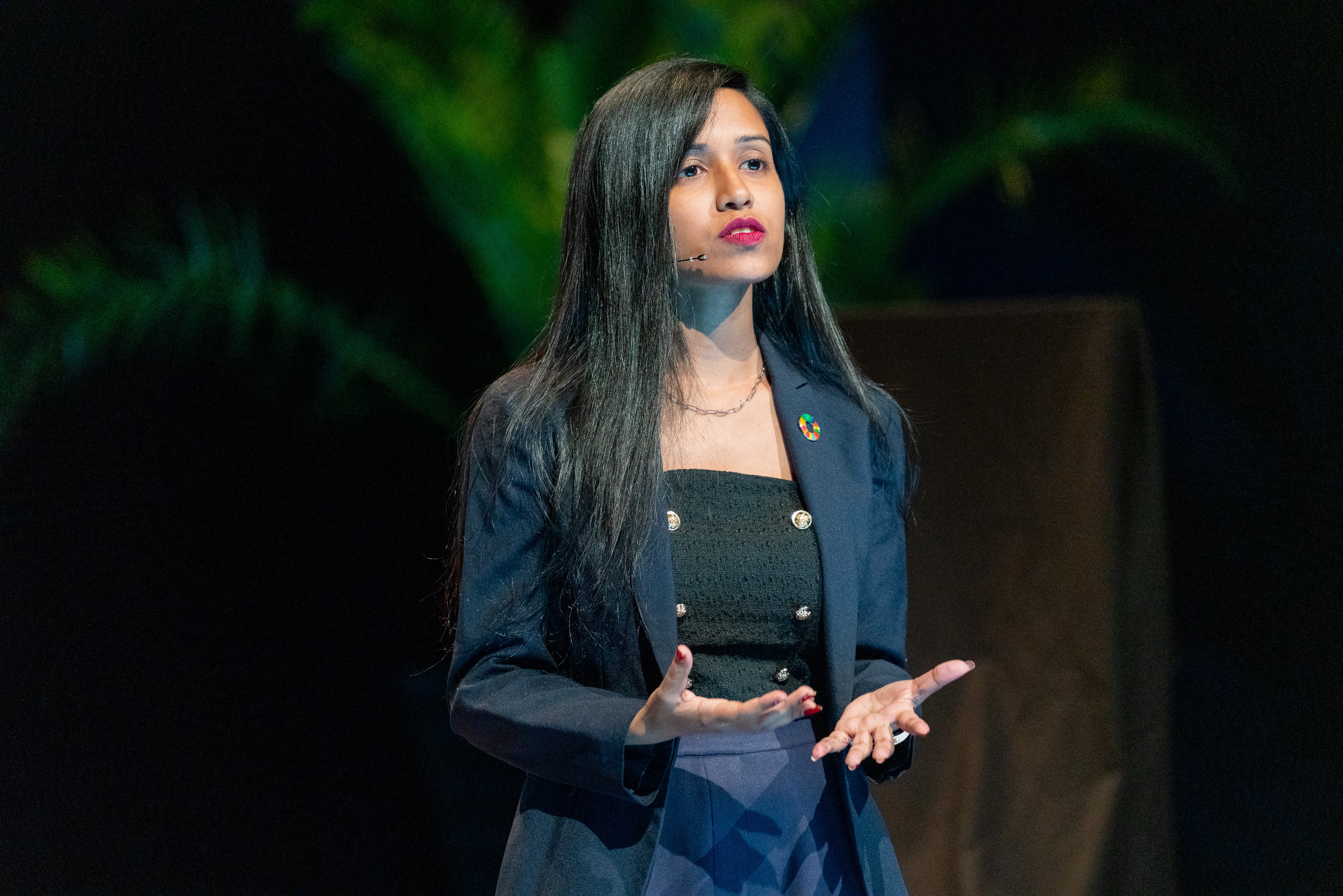
When we talk about “teamship” at Jenson8, we’re interested in what it feels like to be part of a team, not just the org chart, but the lived experience of belonging, safety and pressure. In this edition of Teamship in the Spotlight, Jena Davidson speaks with Shomy Hasan Chowdhury, co-founder of Awareness 360 and global youth leadership advocate, about how her journey has shaped her view of what real teamship looks like.
From small-town community to global teams
Shomy grew up in Mymensingh, a town a few hours from Dhaka in Bangladesh, where life was deeply community centric. Neighbours knew each other, shared food on special occasions and looked after those who were sick; children played together on balconies during power cuts and clapped when the electricity came back.
Those everyday rituals embedded values she still carries into her work: empathy, connection and caring for people beyond transactional roles. Today, living in London and working across cultures, she notices how rare that sense of community can feel in fast-paced, individualised cities.
Awareness 360:teamship as belonging
When she hears the word “teamship”, Shomy immediately thinks of Awareness 360, the non-profit she co-founded. The organisation runs an annual flagship fellowship with more than 500 participants aged 14–25 from over 70 countries and update sits curriculum each year to cover emerging topics such as AI, conflict, and current events.
For her, the word that sits at the heart of teamship is belonging. Great teams are places where you feel you own a piece of the mission and leave a piece of yourself behind, even when you move on. That’s the experience she strives to create for both her core team and the young people they work with.
What strong teams do differently under pressure
In high-pressure situations, the gap between average and exceptional teams becomes obvious. Shomy highlights a few consistent differences:
She sees a myth many leaders fall into focusing on hiring individually impressive performers, rather than intentionally building a group whose skills and perspectives complementeach other.
Safety, unsafety and the hidden cost of honesty
Working with large, diverse groups also brings sharp questions about safety. In programmes where hundreds of young people discuss polarising topics like war, conflict and AI, Shomy constantly weighs whether everyone in the “room” feels safe – including herself.
Safety is threatened in two opposite ways: when topics are too “hush-hush” and people feel they can’t be themselves, and when conversations spiral out of control without the right guardrails. To navigate this, her team invests in structures such as codes of conduct, conflict-resolution mechanisms, and clear guidelines, while recognising that not every scenario can be captured in a two-page policy.
Beyond programme design, there is a deeper, often invisible cost-benefit calculation many people make at work. Speaking up about organisational decisions, values or external conflicts can risk someone’s job, visa status or ability to support their family. “It’s a privilege to be able to grieve, to process our emotions,” she notes; for many, survival comes first.
The unspoken rules:“I don’t know” and authenticity
One of the most powerful “unspoken rules” Shomy would like to see normalised is the ability for anyone – especially senior leaders – to say “I don’t know” without fear.
In many teams, people respond to questions by bluffing or circling around an answer rather than admitting uncertainty, worried it will be held against them in future promotionor performance discussions. The rise of accessible AI tools adds another twist: instead of acknowledging they don’t know, people can quietly ask a chatbot and present the response as their own thinking, blurring the line between real expertise and generated text.
Authenticity, she argues, has become unusually hard currency. From networking events where every conversation has a hidden agenda to corporate messages about “bringing your whole self to work” that few people truly believe, pretence is often the norm. She’s candid about being “burnt out” on performative networking and now prefers serendipitous, un-scripted conversations over pre-planned elevator pitches.
Her own team atAwareness 360 is a deliberate counter example: they build in time for non-work conversation, create space for people to say “I’m not okay today”, and adjust deadlines or expectations in response to real-world crises such as the youth uprising in Bangladesh.
Accountability, boundaries and caring for yourself
Authenticity and care, however, cannot come at the expense of accountability. For Shomy, the balance lies in being honest about personal circumstances and taking responsibility for how your choices affect others – for example, communicating early if you will miss a deadline so teammates can adjust.
She’s also reframing what it means to be a “good teammate” for herself. Historically, she equated commitment with giving everything to every assignment – skipping meals to honour long-booked commitments or pushing through exhaustion to avoid letting others down. Living independently in London has forced a new realisation: if she burns out or becomes ill, there is no built-in support system to catch her.
If she could speak to her younger self, she says, she would advise prioritising herself, protecting her boundaries, and not giving all of herself to everyone else.
So when does realteamship begin?
After almost an hour of rich conversation, Shomy pauses, laughs about wanting to “ask ChatGPT” to help craft the perfect sentence – and then lands on a simple definition:
“Real teamship begins when teams create a safe space for one another, exercise accountability and care for one another.”
At Jenson8, we see those elements play out every day in our immersive simulations: teams grappling with pressure, learning to speak honestly, and discovering how belonging and accountability can coexist.
Shomy’s reflectionsare a reminder that teamship is not a set of abstract values on a wall. It is felt in how we communicate hard news, how we hold space for each other’s reality and how bravely we admit “I don’t know” – together.