
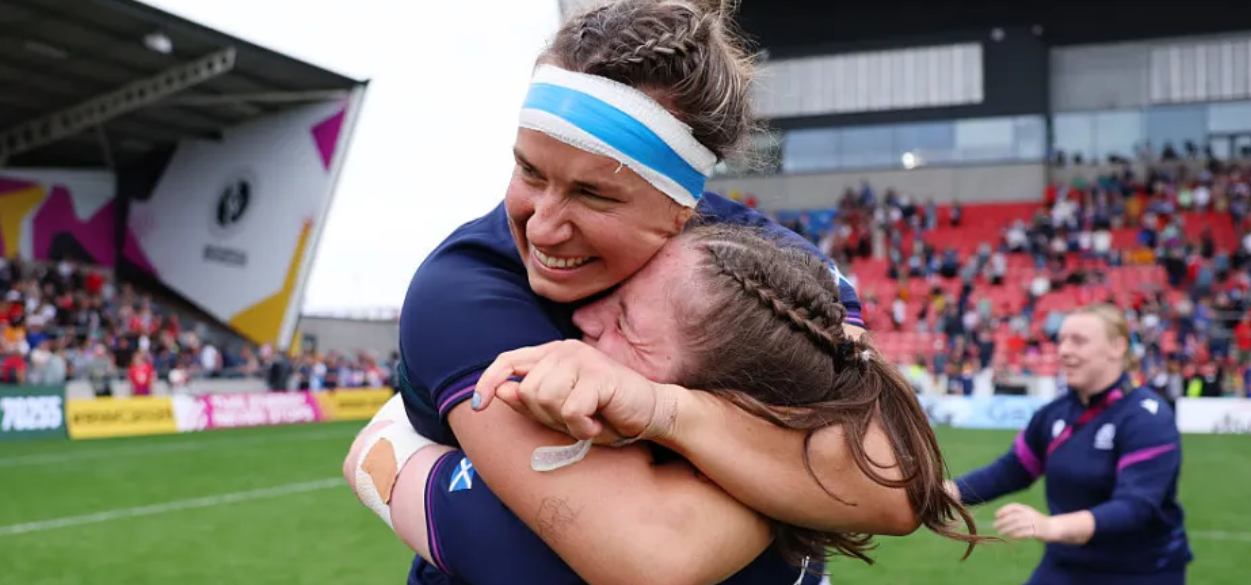
Teamship: In the Spotlight
A conversation between Jena Davidson and Scotland rugby captain Rachel Malcolm
Interviewer: Jena Davidson, Founder of Jenson8
Guest: Rachel Malcolm, Captain of Scotland Rugby
Jena: Rachel, when you hear the word "teamship", what's the first real moment from your career that comes to mind?
Rachel: Probably playing for Scotland in the build-up to the 2021 World Cup. Scotland hadn't qualified for a World Cup for 12 years, and we were in the process of qualifying. But because of COVID, camps and tournaments kept getting cancelled, and our qualification process kept changing.
That was probably the first time as a group that we stuck together as I've never seen before to stay focused on that final goal. The process took about two years in the end. We were constantly getting knocked down. "This has been cancelled." "We're sending you all home." "You're going to live in this house with these two people for the next three months and just turn up for training."
All those little bits that we did or chose to do, I hate the word "sacrifice" probably built the foundations of the team I'm now a part of six years later. That idea of coming together to fight for a common goal builds what I think a team is about. And we did qualify. We went to the World Cup for the first time in 12 years.
Jena: That's incredible. If you think about role models, who shaped your understanding of what great teamship feels like?
Rachel: Probably my dad. He was a rugby player,but he also works in business. As a family, he instilled in us the value of looking out for each other. The way he supported me in both rugby and academics showed me the power of working together and having that support system around you.
Being part of a team is being selfless with the greater good in mind. My dad was the person who instilled that in me from an early age. I'm one of four kids, and he did it for all of us in an equal manner. He's probably still my biggest support system, particularly in sport. Having that selfless support taught me that being part of a team isn't about being the best you can be just so you can be the best it's about being the best you can be so you can support others to be the best they can be.
Jena: What would one behaviour be that tells you a team is safe?
Rachel: How people behave in tough times is the biggest indicator of whether a team is safe or not. I've been very lucky to bepart of very safe teams, but teams that turn on each other when things go wrong and pass blame are unsafe places. Teams where you see accountability and support in those tough times that's what determines safety.
There's a difference between having an open and honest space where you call out behaviours and show vulnerability, where we're not all perfect, and we can all be better and just blame and accusation.Working together to solve problems and see where we can all improve is a safe space.
Jena: So the next section is about the highs when teamship really works. What does it feel like on a Monday morning when you think about your team?
Rachel: Like a buzz. It's effortless and fun to be around. It's a safe environment where you feel supported. We're lucky that we play sports every weekend, so that feeling on a Monday morning can really goup or down. The difference between a Monday after a win when everyone's happy, supportive, focused on the next job versus after a loss, when it's lower, looking for solutions... The highs definitely give you a sense of invincibility.
Jena: Can you give me a moment where you thought, "We really have got each other's backs"?
Rachel: We had some issues with our contracting process within Scotland just prior to our World Cup. A large portion of the team lost their contracts just before the World Cup, and a portion of us kept them. We had to go and compete in a competition where we were split. Some of us had a job at the end, and some of us didn't.
We came together and decided to fight for greater good and show what's so special about our team. Although half the team didn't have contracts and could have said, "That's all well and good for you you're secure," what that did was draw us closer and stronger to fight for what we were there for: to represent our country and do the best we could to further Scottish rugby.
Jena: In high-pressure situations, what did your strongest teams do differently?
Rachel: Played to the strengths of the individuals within it. The times we've struggled in high-pressure moments, I've probably taken a lot on my shoulders and not leaned on the people around me. One of the biggest learnings I've had across my career is: one, I don't know everything; two, I'm not the best at everything; and three, I've got incredible people within my group that I can draw upon in different situations.
In those high-pressure moments, there are certain people I immediately turn to my kind of lieutenants -- and use their knowledge and skill set to help make decisions and execute those decisions to the best of our ability and then impact that on the wider group as well. It's about drawingon everyone's strengths, not being individual in it.
Jena: What would you say is an unspoken rule that everyone lives by?
Rachel: Probably putting the team first, over your personal emotions. Week to week we have selection 23 of us get selected, 15 get selected to start. We're in a squad of about 40, so there's a large chunk of people who are disappointed. But they must turn up to training and still put the team first.
That's a rule we live by, and people notice if you don't follow it. It's putting the team first and knowing you've got the team's support with your emotions, even though your actions have to show otherwise.
Jena: Have you ever been part of a team where teamship quietly broke down?
Rachel: I haven't really been part of a team which has broken down. We've been through a lot, but I've always been part of teams which have stuck together in those moments, which is probably quite rare.
Teams which break down become blame cultures. I've also had issues with coaches, probably more than with my teammates, and I would include management in that. When they become quite frantic, panicky, changing the wheel because they don't trust the process and think everything needs to change, or when they relate the outcome to the process, this can cause issues.
But I'm very fortunate to have been part of teams that have always stuck together, regardless of the highs and lows. Every team has lows, and that blame bit is probably the biggest thing.
Jena: Can you think of a time when you've tolerated something that wasn't great for the sake of harmony?
Rachel: I've had a coach who's been quite aggressive towards players. The way he coached didn't align with my values, but to keep him and the group happy, I probably put up with it for too long and didn't stand up for what I believed in, in case it caused greater harmony.
Jena: Sometimes conflict happens and teams either lean in or stay silent. What's your experience with that?
Rachel: What's interesting about teams is hierarchy. Those who start are much more secure than those who may be on the bench or not selected. Often the fights we're fighting are for those girls that aren't selected. They feel they're in a more vulnerable position, so they can't speak up. It ends up being us that play who must have the voice.
Our outcomes are heavily dependent on our head coach's opinion and selection, so you are vulnerable. That does impact whether you can speak up. But something we've learned within Scotland is the power of our collective. If we have an opinion on a situation and stick to it, we have so much power. We learned that in the last couple of years.
Jena: What's the biggest myth leaders have about building strong teams?
Rachel: The biggest myth about leadership is that they're the best players on a team. For me, the best leaders bring out the best of all the individuals in the team. That doesn't mean you have to be the best to be a good leader.
Jena: When does leadership strengthen teamship, and when does it undermine it?
Rachel: It undermines it when it becomes a dictatorship. You want to create an atmosphere and environment where people can be vulnerable, can be themselves, express themselves, voice their opinions, and be the best person on and off the pitch, in and out of business, as they can be.
It derails when a leader is "my way or the highway." Sport particularly rugby is an incredible environment where you see all shapes and sizes, different ethnicities, sexualities, people tattooed from top to bottom, fake tan, the whole spectrum. What makes rugby so special is that it's an environment where people truly feel they can be themselves. In those environments, you see the best in people.
A lot of leaders I've seen derail teams are so strict: "You've got to be this way, do it my way, and if you don't, it's wrong." I had that opinion at the start of my leadership career. I'm regimented in the way I do things, so everyone should be too. But my best friend and team mate likes to turn up five seconds before a meeting starts, and that makes her feel invigorated, alive, ready to go. I want to be there 10 minutes before. Doesn't mean the way I do it is right or wrong. We're both on time for the meeting, but two different things have made us both feel good about the day.
Jena: Who really carries teamship in tough moments?
Rachel: It probably is a leader, but it doesn't necessarily mean it's your captain. There are different people for different moments, and that's leadership. I don't think leadership is just "this is your leader, the captain, and this is on them."
I'm very high energy on a pitch, very loud and motivating, but there are times when people need just a direct, clear message,and I've got different leaders within my group who step up in those moments. I think it is a leader, but not always the same leader for every situation. That's where you build a leadership team's strength.
I don’t think leadership should ever be in the hands of a single person in any situation. The best leaders have a team of leaders around them who can help in different situations, because no single leader can handle every situation as well as a group of people with different strengths.
Jena: How emotionally honest do you think teams really are versus how honest they pretend to be?
Rachel: There's an element in every team of not wanting to hurt someone's feelings that's human nature. But in high-performance spaces, there are some harsh truths. The more vulnerable a group can be, and the more the whole group can handle that without people having to tread on eggshells, the stronger that group can be, and the easier it is to move forward.
We have situations where you have to speak to different individuals differently because they respond more reactively than others. But high-performance spaces are tough spaces. You're going to be upset sometimes. You're not going to like what people say all the time. But you've got to be vulnerable and willing to learn and grow, or else you're always going to stay where you are.
Jena: Is there a particular emotion that comes out more in high-performing teams?
Rachel: I think anger probably underlies things. But one of my team mates made an interesting point: people only get angry when they know what's been said to them is true.
She used the example: if someone said to a very lean, strong person in our team, "You're fat, you need to loseweight," she wouldn't get angry because she knows she's not fat. But if you said it to someone on the team who might be carrying extra weight, they would get angry, complain about it, and say, "That's so unprofessional." But that is true, and that's why they're angry about it.
Anger is an emotion which comes out when people are forced to face the thing, they're vulnerable about or insecure about. And then on the positive side, the best teams I've been in are teams where everyone celebrates other people's achievements as much as their own. That builds the energy which drives the team.
Jena: How do high-performing teams deal with personal stress and life outside of work without it affecting the team?
Rachel: Rugby is probably the best example of the teams I've been part of. We've had one of our teammates who recently lost her mum. We've got another teammate at the moment whose mum is going through end-of-life care. You wouldn't know how we're acting or how they act, because it's all done very quietly.
What's special about being in these environments is that those people feel unbelievably supported. They want to be in this environment while they go through those things. You wouldn't see it in their performances on the pitch. But the little moments you see, and the level of support people get off the pitch, are what help.
I'm a big believer that everyone has shit. Nobody doesn't have stuff going on at some point or at all points. Having the approach that you're not the only person going through things, treat people the way you want to be treated, is the way forward. We're very lucky that we're in a group of 40-plus girls who are all very compassionate, and we like being around each other. It's not loud and obvious about it. It's those little moments that help people get through it.
Jena: Looking back, what do you wish you'd understood earlier about being a good teammate?
Rachel: That's not to say that everyone must be the same within a team. The best teams are built with individuals with different strengths and different ways of doing things. You should always be open to learning other people's ways.
Jena: If you had to remove one behaviour from teams everywhere, what would it be and why?
Rachel: Blaming other people.
Jena: Final question: finish this sentence honestly. Real teamship begins when...?
Rachel: When times are tough, teams come together to find a solution.
Jena: Rachel, you have been amazing. Thank you so much for your time and your honesty. This has been incredibly valuable.
Rachel: Thank you. I really appreciate it.
If you found this conversation valuable, we'd love to hear your thoughts. What does teamship look like in your world? Where have you seen it strengthen or break down?
This is the first in our series "Teamship: In the Spotlight" exploring what real teamship looks like across sport and industry. Stay tuned for our next conversation.